Key takeaways
- Treat every pentest as one assessment with a clear state, stored in one place.
- Organize the portfolio by testing type, time period and team, because each answers a different question.
- Handle pentest requests as a queue, not as emails.
- Normalize every finding into one model, and classify it by CWE.
- Use CWE grouping to find weaknesses that recur across tests, and fix the pattern instead of each instance.
Anyone who has run a pentest program for more than a year knows the feeling. The web application report from March is still half-remediated when the API test starts in June. The infrastructure vendor sends findings in a different format, with a different severity scale. By the time the red team wraps up in the autumn, the security team is working from four trackers and can’t answer the question leadership actually cares about: how exposed are we right now?
In our pentesting work at Snapsec, we see the same pattern across organizations of every size. The testing is rarely the weak point. What goes wrong is everything around it. Each engagement is managed as its own project, so the program never adds up to more than the sum of its reports.
Managing multiple pentests well isn’t about testing more. It’s about making every engagement feed one program.
Why multiple pentests break the usual way of tracking
Most teams begin by managing each pentest as a standalone project, usually a spreadsheet built from the report. That works for one engagement. At five, it breaks in predictable ways.
Timelines overlap. A new test begins before the previous one’s findings are closed, so remediation runs across several trackers at once.
Report formats and severity scales differ. One vendor rates from Critical to Informational, another uses CVSS, and an internal red team writes narrative findings with no rating at all. Comparing them means translating by hand.
Ownership is set per report, not per system. The same API gateway can appear in an application test and an infrastructure test, with a different owner listed in each.
Nothing connects across engagements. When the same class of weakness appears in three reports, a tracker-per-test model records three unrelated problems. That last one is the most expensive, and we’ll come back to it.
Give every engagement one home
Start by treating each pentest as an assessment: a single record that holds the scope, dates, tester, evidence and every finding the engagement produces. A quarterly web test, an external VAPT, a CI/CD pipeline review and a red team exercise all follow the same structure.
Give every assessment a clear state, so anyone can see where it stands without opening it:
- New: scoped and created, but testing hasn’t started
- Testing Ongoing: testers are active
- Remediation: findings are in and fixes are underway
- Closed: remediation is complete and verified
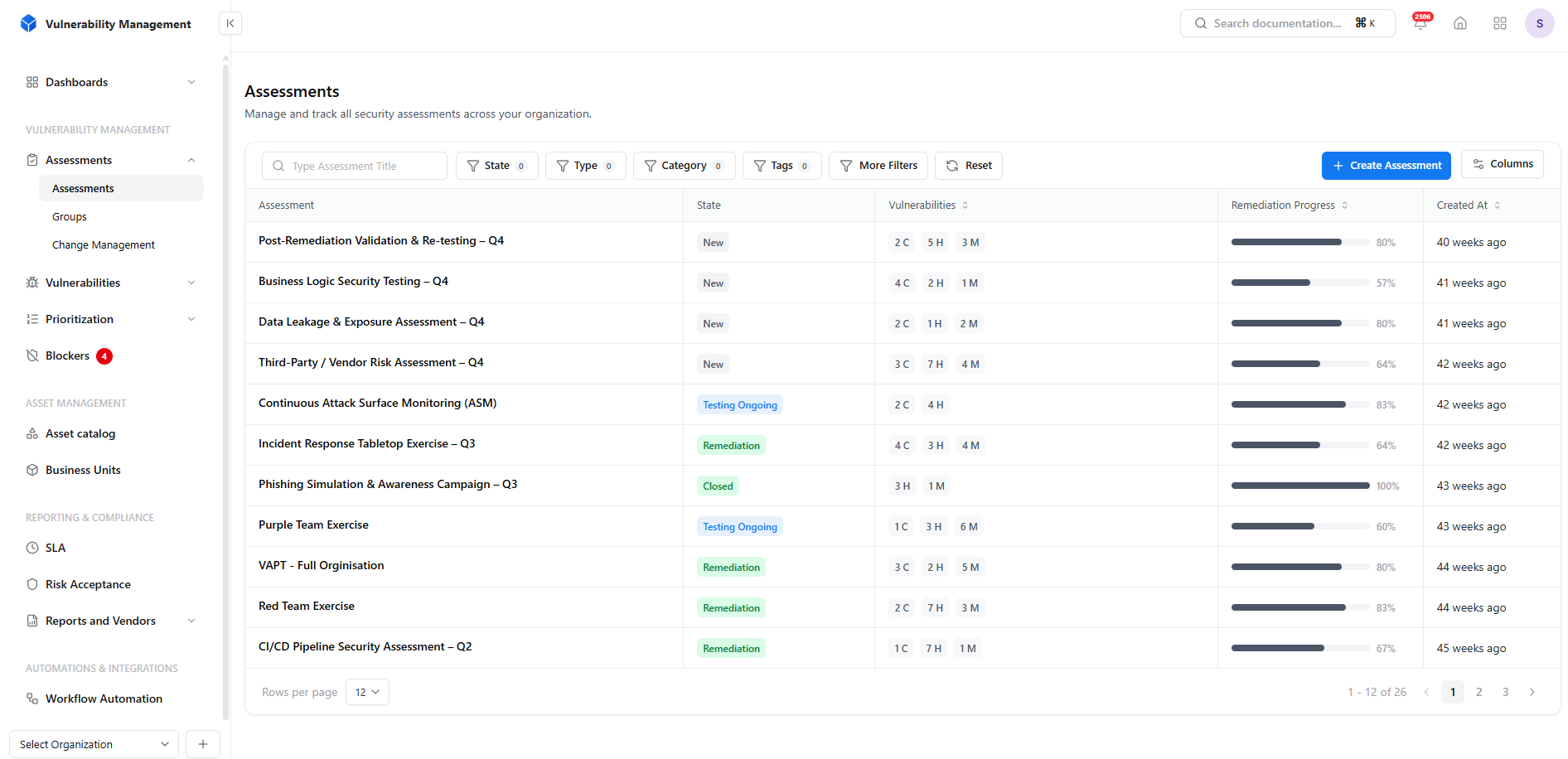
Every engagement in one list, with its state, findings by severity and remediation progress.
Once every engagement lives in one list, questions that used to take an afternoon become a filter. Which tests are still in remediation? Which have open criticals? Which were created this quarter?
Organize the portfolio by category, time and team
A flat list works for a dozen assessments. It stops working when you have 80 of them from three years of testing. Group them in three ways, because different people ask different questions.
By category. Grouping by testing type (API security, infrastructure, mobile, cloud posture, DAST, SAST, red team) shows coverage at a glance. Gaps become obvious, such as APIs that haven’t been tested since a major release, or a category that was never assessed at all.
By time. Quarterly or annual groupings answer the auditor’s first question: what was tested in this period, and what came of it?
Custom. Business units, compliance programs and customer commitments rarely map neatly to a testing type, so give them their own groups.
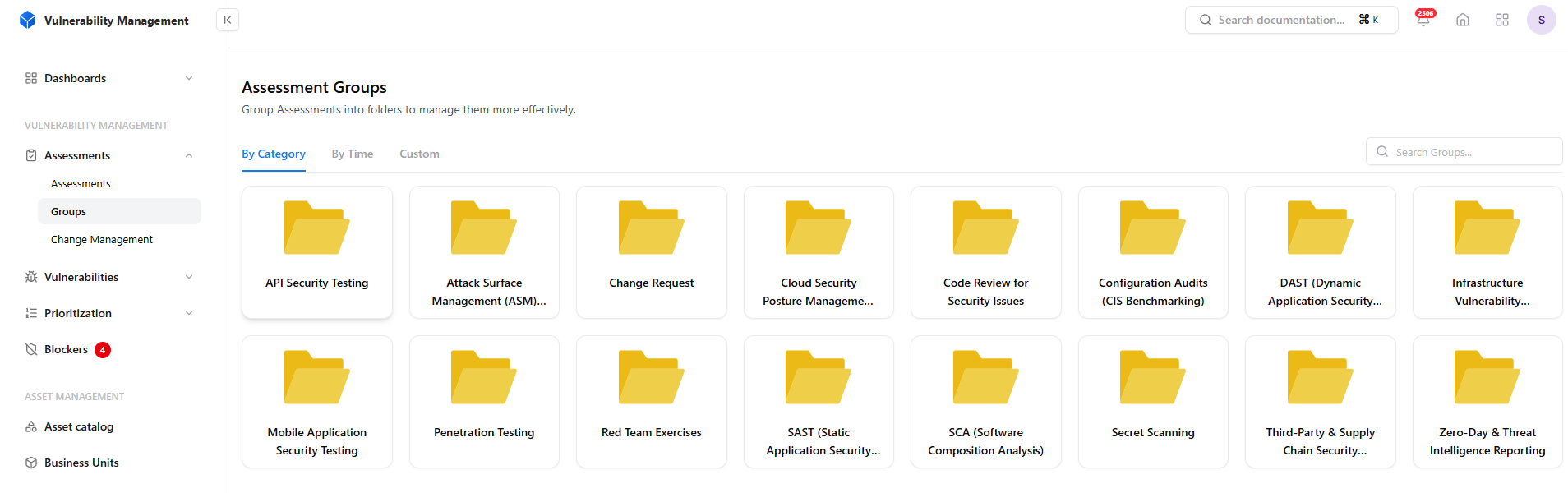
Assessments grouped by testing type, time period or team.
Manage pentest requests before they become engagements
In larger organizations, most pentests start as a request. A product team is shipping a new payment flow, infrastructure is moving to a new cloud region, or a customer contract requires a fresh test before renewal.
When those requests arrive through email and chat, prioritization happens informally. Some systems get tested twice while others are never tested. Treat requests as a queue instead:
- Capture the business unit, the system in scope and the reason for testing
- Track each request’s status from submission through testing
- Link the resulting findings back to the request, so the requesting team sees the outcome of the test they asked for
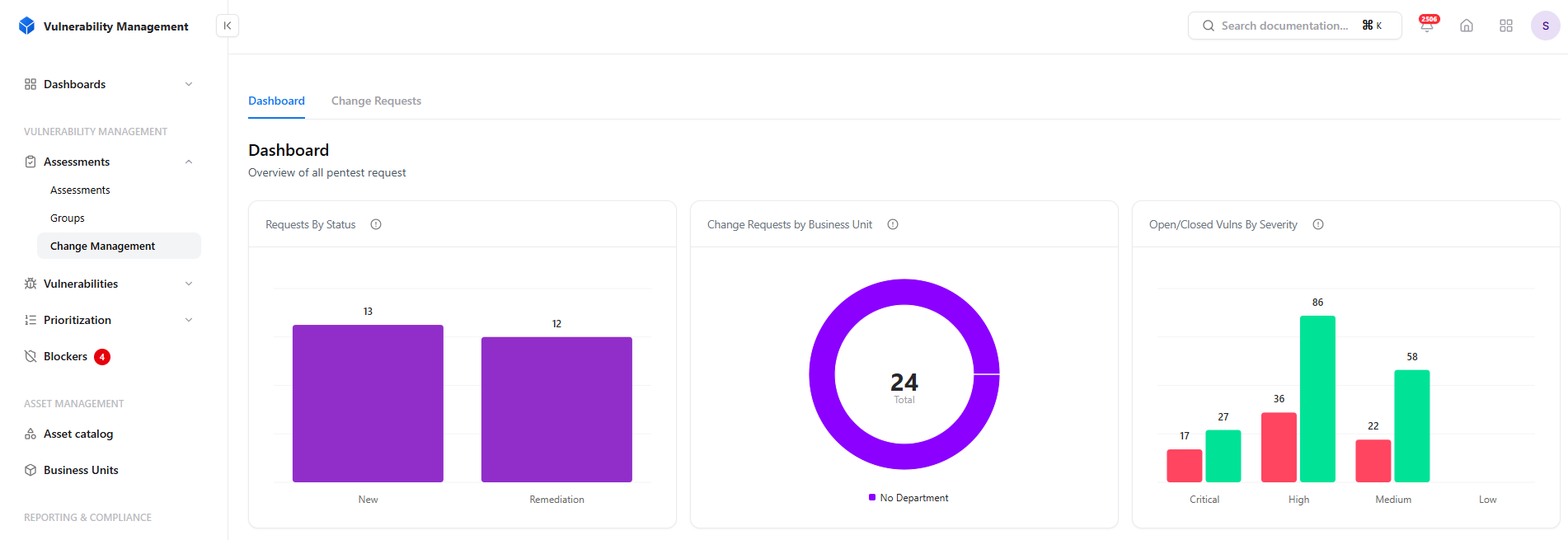
Pentest requests tracked by status, with open and closed findings by severity.
This also gives security leadership a view it rarely has: testing demand. You can see how many requests are waiting, where the open findings sit by severity, and whether testing capacity is keeping up with the pace of change.
Normalize findings so every test speaks the same language
This is the step that turns separate engagements into one program. Wherever a finding came from, once it’s inside your system it should follow the same model:
- One set of states: In Review, Triaged, Fixed in Staging, Retest and Resolved, with Duplicate, False Positive, Not Applicable and Risk Accepted as explicit outcomes
- One severity approach, with the tester’s original rating recorded in the finding for reference
- One owner, tied to the affected asset or business unit rather than to whoever received the report
- A CWE classification on every finding where one applies
The CWE is what connects findings across engagements. Here’s what that looks like in practice.
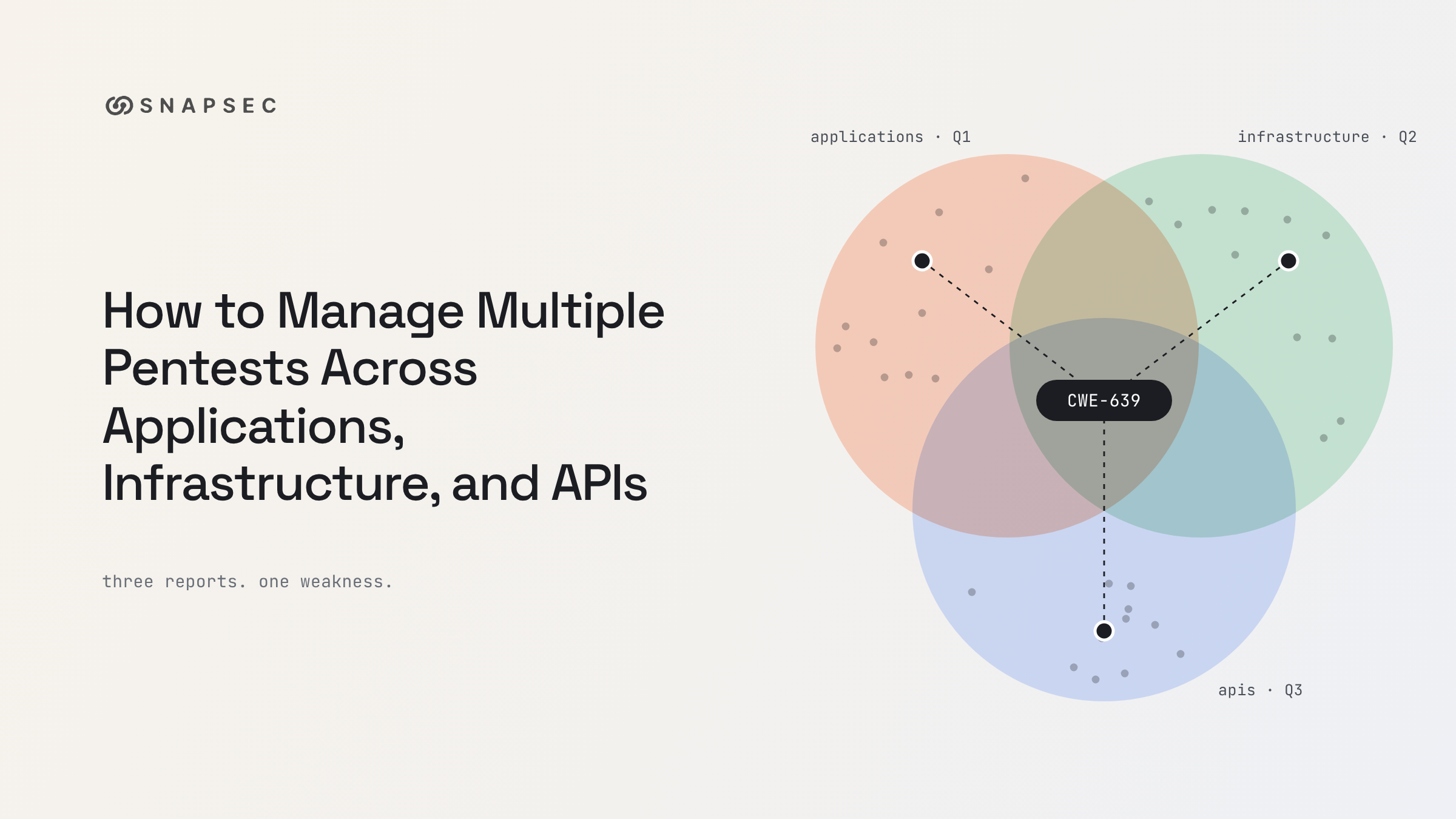
A worked example: one weakness, three reports
Take a fintech company that runs three tests in a year:
- Q1 web application test (Vendor A): an IDOR on
/invoices/{id}lets one customer view another customer’s invoices. Rated High. - Q2 API test (Vendor B): broken object-level authorization on
/v2/accounts/{id}/statements. Scored CVSS 8.1. - Q4 internal red team: a support-panel endpoint returns any user’s KYC documents when the record ID is changed. Written up as a narrative finding with no score.
Managed as three separate reports, these become three tickets for three teams, fixed three different ways, months apart. Each fix is correct, and the fourth instance is already waiting in the next release.
Classified by CWE, all three land in the same group: improper access control, specifically authorization bypass through a user-controlled key. Seen together, the real finding is obvious. Authorization is checked separately in each controller instead of being enforced by a shared policy layer. The right fix is one centralized authorization check, delivered as one piece of engineering work, which prevents the next instance instead of patching the last three.
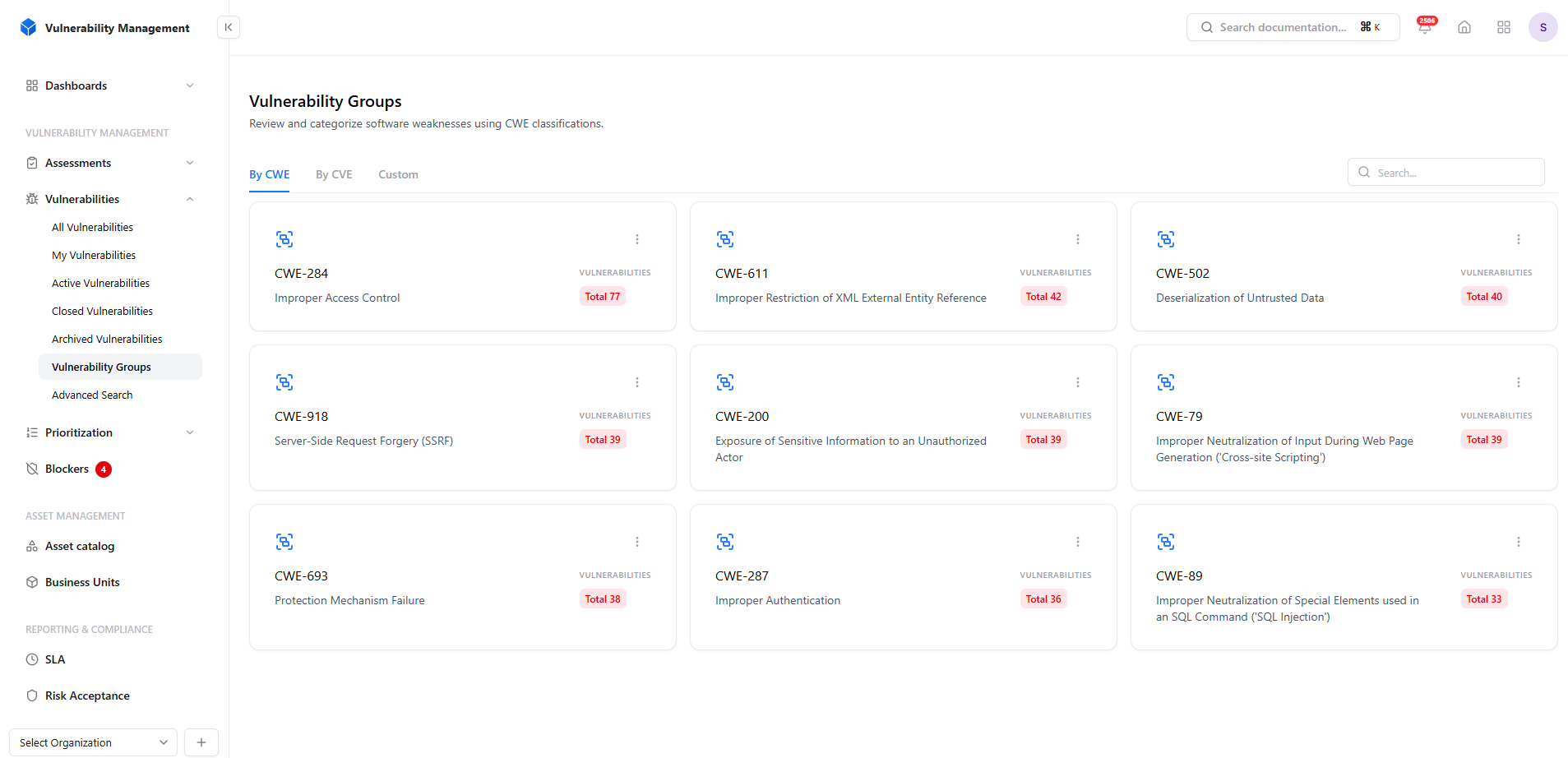
Findings grouped by CWE across every engagement, so recurring weaknesses stand out.
That’s the payoff of normalization. No single pentest report could have told you this. The program can.
Measure the program, not the report
With engagements, requests and findings in one place, you can report on the pentest program as a whole instead of summarizing one test at a time. Four measures matter most:
- Remediation progress per assessment: which engagements are stalling and which are nearly closed.
- Open findings by severity across all tests: your real current exposure, whatever report each finding came from.
- Recurring weakness classes: the CWEs that appear engagement after engagement, and where engineering investment will pay off most.
- Coverage by category and time: which systems or testing types haven’t been assessed recently.
These are the numbers leadership, customers and auditors actually ask for. None of them can be produced reliably from a folder of reports.
One program, not many reports
Running pentests across applications, infrastructure and APIs is normal for any organization of meaningful size. The fragmentation that usually comes with it isn’t inevitable. When every engagement has one home, every request goes through one queue and every finding follows one model, each new pentest adds to a clear picture of your security posture. And sometimes it reveals the pattern that makes the next three findings disappear.
Snapsec VM is built around this model: assessments with consistent states, grouping by category, time or team, a managed queue for pentest requests, and findings grouped by CWE and CVE across every engagement. Explore the live demo or read more about managing assessments in the Snapsec docs.
Frequently asked questions
How often should APIs be pentested separately from web applications?
Whenever the API is a product in its own right: public or partner-facing, versioned independently, or consumed by mobile apps. A web application test usually covers only the API calls the front end makes, and misses endpoints, versions and parameters the UI never touches. Most teams test APIs at least annually and after major version changes.
Should different pentest vendors use the same severity scale?
Ideally yes, but you can’t always control it. What matters more is normalizing findings once they arrive. Record the vendor’s rating, then assess severity consistently in your own context.
What’s the difference between grouping by CWE and grouping by CVE?
CVEs identify specific vulnerabilities in specific software, such as a known flaw in a library version. CWEs describe the underlying weakness class, such as improper access control. Pentest findings in custom code rarely have CVEs, so CWE grouping is usually what reveals patterns across engagements.
When should an assessment be marked closed?
When every finding has reached a final outcome: resolved and verified by a retest, or formally closed as a duplicate, false positive, not applicable or accepted risk, with a reason recorded.