The Old Penetration Testing Approach and How Snapsec Fixes It
For years, penetration testing has been treated as the ultimate proof of security maturity. Schedule a test, receive a report, fix the findings, and repeat the cycle next quarter or next year. On paper, this model appears rigorous. In practice, it no longer aligns with how infrastructure is built, changed, or attacked.
Modern environments do not stand still long enough for point-in-time testing to remain reliable. Cloud automation, CI/CD pipelines, third-party integrations, and continuous deployment mean that exposure evolves daily—sometimes hourly. Yet penetration testing still operates as a snapshot exercise, frozen in time the moment the engagement ends.
Snapsec Vulnerability Management (VM) was built to address this mismatch by replacing episodic testing with a continuous, lifecycle-driven security model.
Why Traditional Penetration Testing No Longer Holds
The traditional penetration testing approach is fundamentally reactive. It answers one question well: what was exploitable at the moment the test was conducted? It does not answer the questions security teams actually struggle with today:
What changed after the test ended?Which newly deployed assets were never tested?Which exposures emerged through automation, vendors, or configuration drift?Which vulnerabilities became exploitable weeks later due to threat evolution?
Pen tests typically operate on a predefined scope, provided manually, and validated once. Anything outside that scope—unknown subdomains, transient APIs, vendor-hosted assets, or short-lived services—simply does not exist as far as the test is concerned. The result is a false sense of completeness.
Even when findings are accurate, remediation is disconnected. Reports arrive as static documents, vulnerabilities are logged without asset context, and prioritization is driven by severity ratings rather than exploitability or business impact. Security teams end up fixing what was tested, not necessarily what is most dangerous.
The Core Gap: Testing Without Lifecycle Awareness
Security exposure is no longer a single event. It has a lifecycle.
Assets are created, modified, exposed, misconfigured, fixed, and re-exposed continuously. Vulnerabilities appear, change relevance, gain exploitability, or become irrelevant as infrastructure evolves. Threats shift faster than reporting cycles.
Traditional penetration testing ignores this lifecycle. It treats exposure as a one-time discovery problem rather than an ongoing risk management problem.
Snapsec VM was designed around this reality.
How Snapsec VM Replaces Point-in-Time Testing with Continuous Validation
Snapsec does not attempt to replace penetration testing with automation alone. Instead, it modernizes the underlying model by embedding testing into a continuous vulnerability lifecycle.
The shift is structural, not cosmetic.
Phase 1: Continuous Asset Awareness as the Foundation
Penetration testing assumes the asset list is correct. Snapsec VM does not.
Snapsec continuously discovers and tracks all internet-facing assets tied to an organization, including domains, subdomains, APIs, services, cloud endpoints, and vendor-hosted exposure. This discovery is persistent, not periodic, ensuring that new assets enter the security workflow as soon as they become reachable.
This eliminates one of the largest blind spots in traditional testing: assets that were never in scope because they did not exist—or were not known—at the time of assessment.
Phase 2: Vulnerability Detection with Context, Not Just Coverage
Snapsec VM identifies vulnerabilities across the live external attack surface, but detection alone is not the objective. Every vulnerability is mapped back to:
- The asset it affects
- The environment it belongs to
- How it became exposed
- Whether exposure increased recently
- How attackers could realistically reach it
This context transforms vulnerability data from a list of issues into a map of real attack paths.
Traditional penetration testing may identify a vulnerability. Snapsec VM explains whether it matters now.
Phase 3: Risk-Driven Prioritization Instead of Severity Guesswork
Severity scores alone were never meant to drive remediation at scale. Snapsec VM prioritizes vulnerabilities based on exploitability, exposure, and relevance—not theoretical impact.
By correlating vulnerability intelligence with exposure changes and attacker behavior patterns, Snapsec surfaces what increases real-world risk instead of what merely exists.
This replaces the common post-pen-test problem where teams are overwhelmed by findings but unclear on what to fix first.
Phase 4: Continuous Validation Instead of One-Time Assurance
One of the most critical failures of penetration testing is that fixes are assumed to be permanent.
Snapsec VM continuously validates whether vulnerabilities are actually remediated, whether services were truly closed, and whether exposure reappears due to configuration drift or redeployment.
Security teams no longer rely on “fixed” status in tickets. They rely on observed reality.
Phase 5: Lifecycle Visibility for Security and Leadership
Penetration testing produces reports. Snapsec VM produces trends.
Teams can see how exposure evolves, how remediation improves over time, where risk accumulates, and which changes introduce the most security debt. This allows security leadership to reason about risk reduction as a measurable process rather than a reactive exercise.
This visibility turns vulnerability management into an operational discipline, not a compliance checkbox.
What Snapsec Actually Changes for Organizations
By modernizing penetration testing into a continuous lifecycle, Snapsec VM shifts security posture in measurable ways:
- Unknown assets stop slipping through testing gaps
- New exposure is detected before attackers find it
- Remediation focuses on exploit paths, not noise
- Fixes are verified, not assumed
- Risk trends become visible instead of episodic
Most importantly, security stops reacting to reports and starts managing exposure as a system.
Why This Is Not “Automated Pen Testing”
Snapsec VM is not trying to simulate attackers once every few months. It mirrors how attackers actually operate: continuously, opportunistically, and focused on change.
Where penetration testing validates a moment, Snapsec validates reality.
Closing Perspective
The old penetration testing model was built for static infrastructure and predictable change. Modern environments are neither.
Snapsec VM replaces episodic testing with a full vulnerability lifecycle—one that accounts for continuous discovery, contextual risk, real-world prioritization, and persistent validation.
This is not about running more scans. It is about making vulnerability management match how systems are built-and how attackers actually think.
That is how Snapsec turns penetration testing from a snapshot into a living security control.
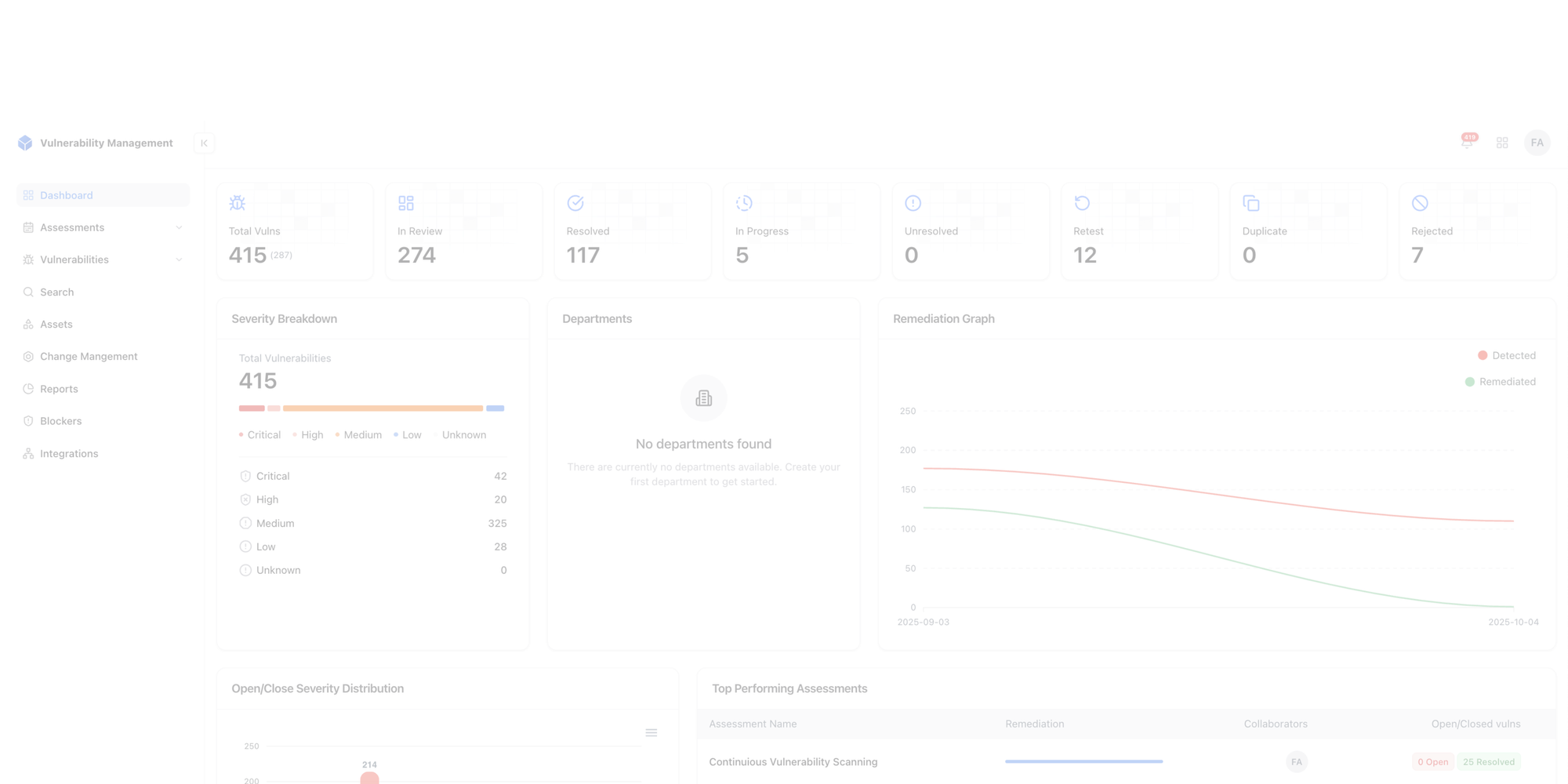
Centralise your Appsec
A single dashboard for visibility, collaboration, and control across your AppSec lifecycle.
Explore Live Demo