Lack of SLA Enforcement - and How the SnapSec Suite Fixes It
Service Level Agreements (SLAs) in vulnerability management were introduced to solve a concrete operational problem: how quickly a known security weakness must be addressed once it is identified. In theory, SLAs translate risk into action by defining time-bound remediation expectations. In practice, however, SLAs are often configured, reported, and then silently violated - especially in environments where penetration testing and vulnerability assessments operate as periodic, disconnected exercises.
The result is not a lack of data, but a lack of enforcement. Findings exist, deadlines exist, and yet remediation timelines drift without clear accountability or system-level feedback. SnapSec approaches this problem by treating SLA enforcement not as a reporting feature, but as a first-class operational primitive embedded into how vulnerabilities are ingested, normalized, tracked, and resolved across their entire lifecycle.
This blog examines why traditional SLA models fail in real-world security operations, particularly in pentest-driven programs, and how SnapSec’s vulnerability management (VM) architecture introduces a fundamentally different way to operationalize SLAs at scale.
Why SLA Enforcement Breaks Down in Traditional Pentest Workflows
Penetration tests are commonly positioned as high-signal security exercises. They produce curated findings, contextual impact, and exploitability insights that automated scanners often lack. However, once the engagement ends and the report is delivered, most organizations revert to generic vulnerability tracking mechanisms that are poorly suited for enforcing time-bound remediation.
The first structural issue is that SLAs are usually applied after ingestion, not during it. Pentest findings are uploaded as PDFs, spreadsheets, or tickets, then manually classified into severity buckets. SLA clocks start late, often after internal triage, which immediately undermines their purpose. In some cases, different teams reinterpret severity differently, leading to inconsistent SLA mapping across identical classes of issues.
The second issue is fragmentation. Pentest findings live in one system, scanner findings in another, cloud misconfigurations in a third, and ticketing systems operate independently. SLAs may exist in policy documents, but no single system enforces them across these sources. What emerges is a reporting layer that shows SLA compliance at a point in time, without any continuous control over how violations occur or persist.
Finally, traditional models rely heavily on manual follow-up. Engineers track SLA breaches through periodic reviews or dashboards that highlight overdue items after the fact. There is little system-driven behavior that changes because an SLA is approaching or has been violated. Enforcement becomes reactive, dependent on human attention rather than system design.
SnapSec’s View: SLAs as a Core Control Plane, Not a Metadata Field
SnapSec treats SLAs as an operational control plane that governs how vulnerabilities flow through the system from the moment they are created. This design choice is especially important for pentest-derived findings, where context and severity are high, but operational follow-through is often weakest.
In SnapSec VM, SLA configuration is not an overlay. It is bound directly to vulnerability objects at ingestion time. When a pentest finding is onboarded, whether via direct integration, structured upload, or API ingestion, the system evaluates it against predefined SLA policies based on multiple dimensions: severity, asset criticality, environment, and exposure context.
This means the SLA timer starts deterministically and immediately. There is no dependency on downstream ticket creation or manual tagging. The vulnerability object itself carries its SLA state, and that state is continuously recalculated as conditions change.
For example, if a medium-severity pentest finding exists on a non-production system, it may initially fall under a relaxed SLA. If that same asset is later reclassified as internet-facing or business-critical, SnapSec automatically re-evaluates the SLA without duplicating the finding or resetting its history. Traditional systems would treat this as a separate tracking problem; SnapSec treats it as a state transition within the same vulnerability lifecycle.
How SnapSec Solves the SLA Problem Specific to Pentests
Pentest findings introduce a unique SLA challenge: they are fewer in number but higher in contextual importance. SnapSec addresses this by preserving pentest-specific semantics while enforcing uniform remediation discipline.
When pentest findings are ingested, SnapSec normalizes them into its internal vulnerability model without stripping away exploit paths, impact narratives, or attack preconditions. These attributes are not stored as static text; they influence prioritization logic and SLA evaluation. A finding with proven exploitability or demonstrated lateral movement potential can be mapped to a stricter SLA, even if its CVSS score alone would suggest otherwise.
Unlike traditional approaches where pentest findings are “tracked separately,” SnapSec places them into the same SLA-governed workflow as continuous findings. This unification matters operationally. It allows teams to answer questions such as: which pentest findings are approaching breach, which have already violated SLA, and which are blocked by dependency or ownership issues—all without maintaining a parallel process.
Crucially, SnapSec does not treat SLA violation as a passive state. When a pentest finding crosses defined SLA thresholds, the system can trigger workflow changes: escalation to different ownership groups, increased visibility in remediation queues, or enforcement actions through integrated ticketing systems. The behavior of the platform changes as SLA risk increases, rather than merely reporting that a deadline has passed.
Continuous SLA Awareness Instead of Periodic SLA Reporting
Most vulnerability management platforms surface SLA status through dashboards that are reviewed weekly or monthly. This cadence is incompatible with modern environments where assets, exposures, and priorities change continuously.
SnapSec’s SLA engine operates continuously and contextually. Every relevant event, asset discovery, exposure change, ownership reassignment, vulnerability state update, can trigger an SLA recalculation. This ensures that SLA status is always derived from the current operational reality, not from the conditions that existed when the finding was first imported.
From an engineering standpoint, this requires tight coupling between the data model and workflow orchestration. SnapSec maintains a unified data graph where vulnerabilities, assets, owners, environments, and remediation actions are first-class entities. SLA state is computed from this graph, not inferred from static timestamps or external systems.
For security teams, the practical effect is that SLA enforcement becomes proactive. Instead of discovering breaches during audits or quarterly reviews, teams can see SLA pressure building in real time and act before violations occur.
Reducing Noise Without Diluting Enforcement
A common failure mode in SLA-driven programs is noise. When too many findings are governed by the same rigid timelines, teams either ignore the SLAs or continuously override them. SnapSec addresses this by making SLA policies expressive enough to reflect real operational constraints without weakening enforcement.
Rather than a single severity-to-SLA mapping, SnapSec allows SLA logic to incorporate asset role, exposure, and validation state. False positives, accepted risks, or mitigated findings are not left to manual suppression; they transition into states that explicitly alter or pause SLA enforcement with auditability.
This distinction is critical. SnapSec does not remove findings from SLA consideration silently. Every deviation from standard SLA behavior is modeled as a deliberate state with traceable justification. This preserves the integrity of SLA metrics while avoiding the operational fatigue that causes teams to abandon them entirely.
Operational Ownership and Accountability Built Into the SLA Model
Another reason SLAs fail is unclear ownership. When vulnerabilities move between teams or systems, SLA responsibility often becomes ambiguous. SnapSec’s workflow model ties SLA enforcement directly to ownership assignments that are part of the core data model, not external annotations.
When a pentest finding is assigned or reassigned, the SLA clock does not reset arbitrarily. Instead, SnapSec records the transition, preserves elapsed time, and continues enforcement unless policy explicitly defines otherwise. This prevents a common loophole where findings are reassigned to avoid apparent SLA breaches.
At scale, this design enables meaningful accountability. Security leaders can analyze SLA compliance by team, asset class, or vulnerability category with confidence that the underlying data reflects actual remediation behavior, not reporting artifacts.
A Different Operational Outcome
The net effect of SnapSec’s approach is that SLAs stop being retrospective metrics and start functioning as active controls. Pentest findings are no longer exceptional cases that require separate tracking and manual follow-up. They are governed by the same continuous enforcement logic as all other exposures, while still retaining their unique technical context.
Security teams using SnapSec operate with a clearer understanding of where SLA risk is accumulating, why it is happening, and what system-level actions are available to address it. Enforcement is not dependent on periodic reviews or individual diligence; it is embedded into the lifecycle of every vulnerability.
Conclusion
SLA enforcement in vulnerability management fails when it is treated as a reporting obligation rather than an operational system behavior. This failure becomes especially visible in pentest-driven programs, where high-impact findings often drift beyond their intended remediation windows despite clear documentation and intent.
SnapSec addresses this problem by embedding SLA logic directly into its vulnerability management architecture. Through immediate enforcement at ingestion, continuous recalculation based on context, and workflow-level responses to SLA pressure, SnapSec transforms SLAs from static deadlines into living controls.
The result is not tighter reporting, but more predictable remediation outcomes. Security teams gain a system that reflects how their environments actually change and enforces remediation expectations accordingly—without relying on manual oversight or fragmented tooling.
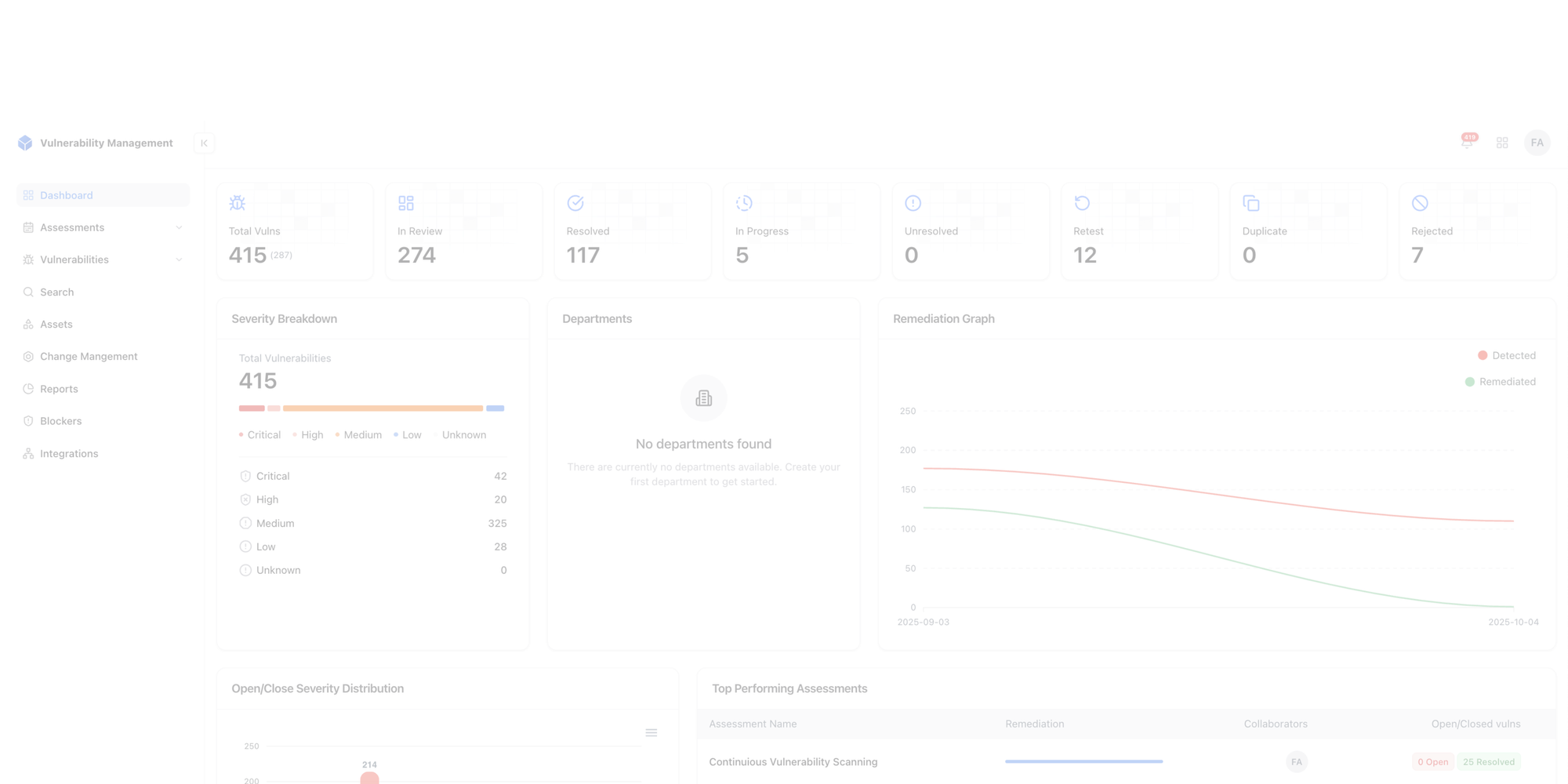
Centralise your Appsec
A single dashboard for visibility, collaboration, and control across your AppSec lifecycle.
Explore Live Demo