Why External Security Signals Fail Without Context
Modern security teams are not blind. They discover exposed ports, enumerate subdomains, track DNS changes, and ingest continuous external telemetry. Dashboards are full. Alerts are flowing.
Yet breaches still happen—not because signals were missed, but because signals were not understood.
The real failure is no longer detection. It is context.
At most organizations, external security findings arrive as isolated facts: a port is open, a service is reachable, a record changed. What’s missing are the answers to the questions that actually determine risk.
Why did this change happen?
Is it new or has it existed for months?
Did it expand exposure, or simply shift infrastructure?
Does it matter now?
Without those answers, security teams are forced to guess.
How This Problem Actually Shows Up Inside Companies
Imagine a growing SaaS company operating across multiple cloud accounts, regions, and CI/CD pipelines.
One morning, the security team receives an alert: a new subdomain has appeared - admin-api.company.com, exposed on a non-standard port.
The alert is accurate. It is also incomplete.
There is no immediate visibility into whether this asset came from a planned deployment, an automated pipeline, a third-party integration, or an accidental misconfiguration. There’s no historical baseline showing when it appeared or what changed compared to yesterday. Authentication posture is unclear. Ownership is unclear.
Security escalates.
DevOps responds: “Looks expected.”
he issue quietly de-prioritizes.
Weeks later, the same endpoint is abused via credential stuffing—because it was never intended to be internet-facing.
Nothing failed at the scanning layer. What failed was interpretation.
This pattern repeats at scale. DNS records change, but teams can’t tell whether email security was weakened or a vendor rotated infrastructure. Ports are temporarily exposed during testing, but no one verifies closure. External scanners report static findings while infrastructure underneath is continuously mutating.
The result is not ignorance—it’s ambiguity.
Why This Is a Technical Failure, Not a Process One
Externally exposed infrastructure is not static. It is shaped by cloud orchestration, auto-scaling, CI/CD pipelines, infrastructure-as-code, third-party services, and short-lived environments.
When security tools report findings without correlating them to change events, teams lose the ability to reason about risk over time. Technically, this creates predictable failure modes. Security teams can’t distinguish new exposure from long-standing surface area. Engineers can’t tell whether a change increased or reduced risk. Prioritization becomes driven by visibility instead of impact.
Over time, alert fatigue sets in—not because teams are careless, but because alerts lack narrative. Findings become interruptions rather than insights. DevOps learns to dismiss them reflexively. Leadership receives reports full of issues but empty of decisions.
This is how security slowly becomes reactive by default.
How Attackers Take Advantage of This Blind Spot
Attackers don’t scan the internet once. They scan it continuously. They look for deltas - new endpoints, newly reachable services, modified authentication paths, and brief exposure windows created by change.
They don’t need zero-days when defenders can’t tell what changed yesterday. In many breaches, the vulnerable surface existed in plain sight for weeks or months. The difference wasn’t visibility - it was understanding.
The attackers had timing. The defenders had noise.
Why Existing Tools Don’t Fully Solve This
Most external security tools answer “what exists.”
Very few answer “what changed” or “why it matters now.”
They treat the attack surface as an inventory, not as a system with memory. Findings are reported as static events, not evolving exposure paths. That gap is where risk hides.
How Snapsec Restores Context to External Security
Snapsec treats the external attack surface as a living system, not a static list.
Instead of surfacing isolated findings, Snapsec tracks how exposure evolves over time and explains what those changes mean from a security perspective.
When a new asset appears, Snapsec shows:
When it emerged.
What changed compared to the previous state.
Whether it expanded real exposure or reflects expected behavior.
When configurations shift, Snapsec highlights risk deltas, not just differences. By combining historical baselines, asset intelligence, and attacker-style reconnaissance, Snapsec turns raw signals into operational understanding.
Security teams stop asking “What is this?”
They start answering “Does this matter right now?”
Where Guesswork Ends
Security doesn’t fail because teams don’t see enough. It fails when what they see cannot be trusted, prioritized, or acted on with confidence.
As attack surfaces become more fluid and attackers more patient, the cost of misunderstanding change grows quietly — but significantly. Every unexplained exposure, every unowned endpoint, and every dismissed alert creates space for adversaries to operate undetected.
Snapsec closes that gap by restoring meaning to external security. By anchoring findings in history, change, and real-world impact, it allows organizations to move beyond reaction and into control.
This is where external security stops being a guessing game - and starts becoming a decision engine.
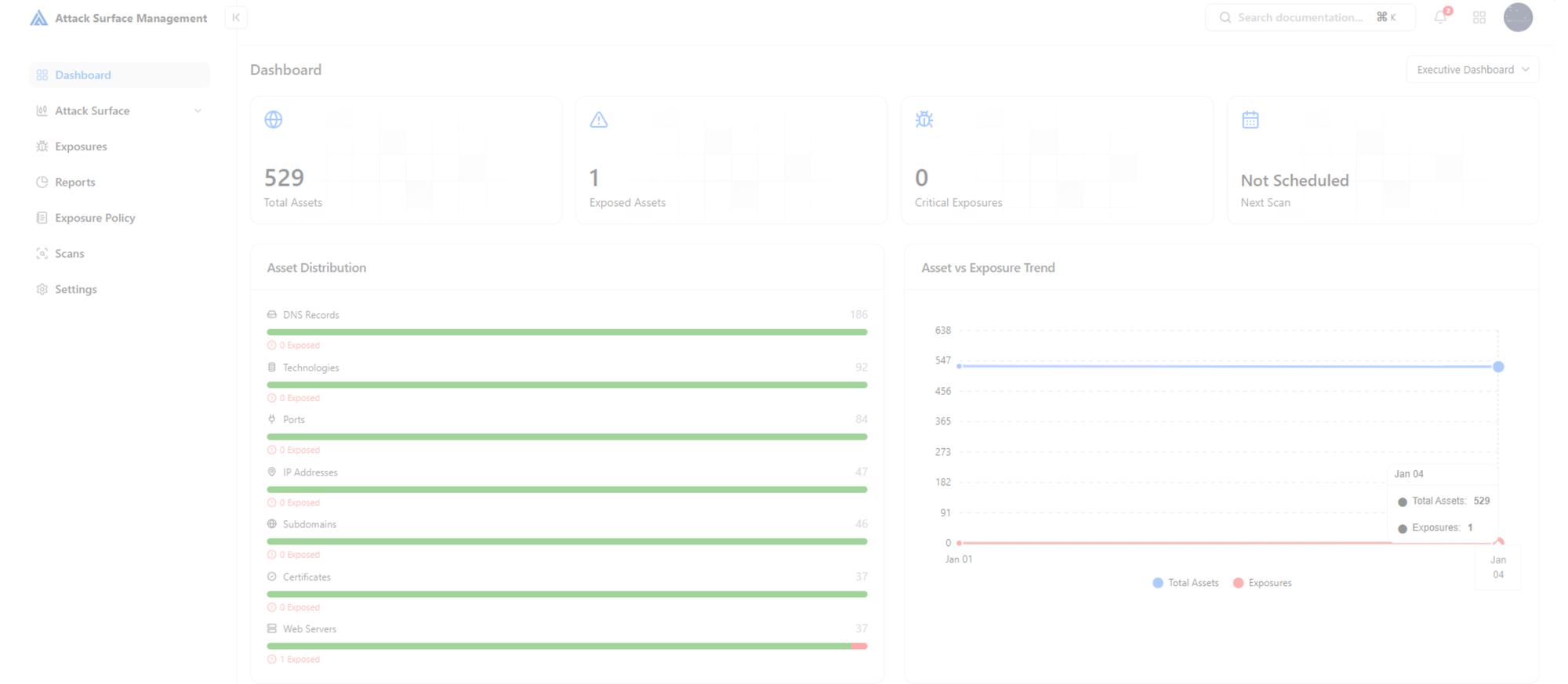
Centralise your Appsec
A single dashboard for visibility, collaboration, and control across your AppSec lifecycle.
Explore Live Demo