Attack Surface Blindness
Most organizations believe they understand their security posture because their internal controls are strong. Firewalls regulate traffic, EDR monitors endpoints, SIEM correlates logs, and IAM governs identities. Inside the perimeter, visibility is high and response is mature.
Yet breaches increasingly begin before any of those tools see activity.
The reason is simple: internal security controls are not designed to observe the internet-facing layer where attackers start. This is not a tooling failure. It is a boundary mismatch. Attackers operate at the internet edge, while most defenses activate only after access has already been gained.
This is where Attack Surface Management becomes necessary.
The Core Problem: Internet Exposure Exists Outside Security Control
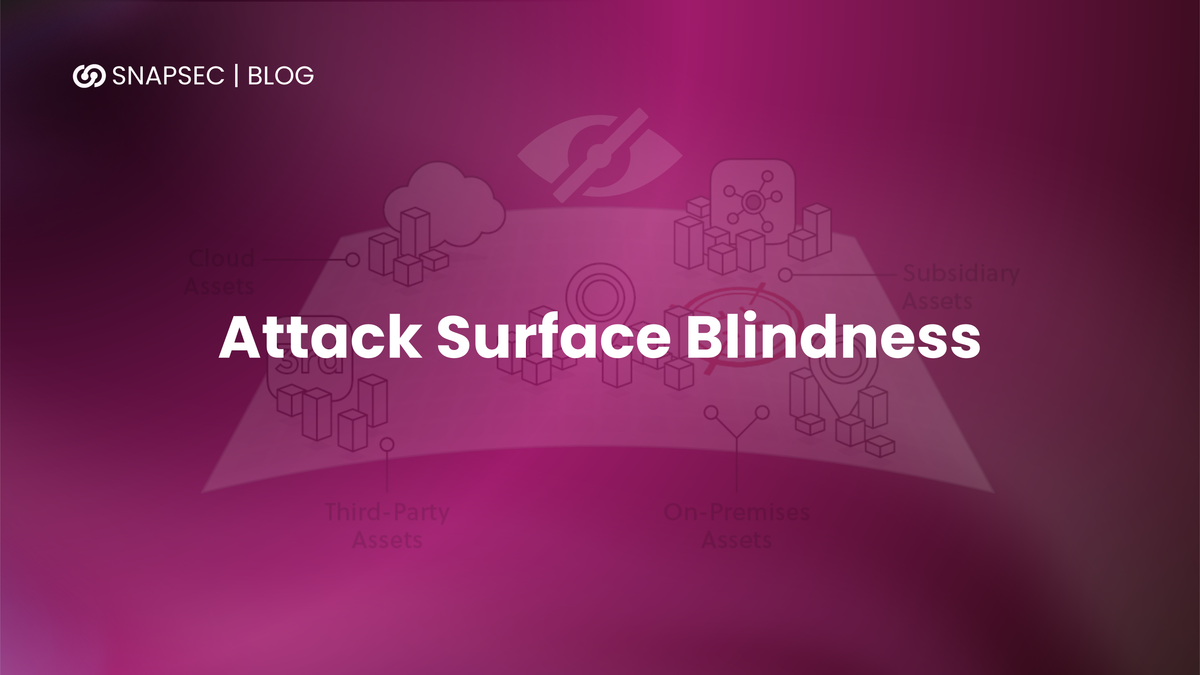
Every modern organization exposes far more than it realizes. Domains, subdomains, APIs, web applications, cloud services, and vendor-hosted endpoints accumulate over time through automation, growth, and integration.
These assets often exist:
- Outside internal networks
- Without endpoint agents
- Without firewall enforcement
- Without consistent ownership
- Without continuous monitoring
Security tools that rely on logs, agents, or authenticated access simply do not see them.
From a technical perspective, this creates a blind zone: systems that are reachable, exploitable, and attractive to attackers, but invisible to internal defenses.
How This Failure Happens in Practice
Consider how exposure is actually created.
A CI/CD pipeline spins up a temporary service for testing and leaves it reachable. A new subdomain is added for a feature rollout and never retired. A vendor integration requires DNS delegation and introduces externally hosted endpoints under the company’s domain. A cloud service is exposed during troubleshooting and quietly persists.
None of these actions are malicious. All of them are common.
But without continuous external visibility, no system answers:
- What just became reachable from the internet?
- Was this exposure expected?
- Did it increase risk compared to yesterday?
- Is this now part of a real attack path?
Attack Surface Management exists to answer those questions continuously.
Why Internal Security Tools Cannot Solve This
Firewalls control known traffic paths but do not discover unknown services. EDR detects behavior on managed hosts, not unmanaged internet-facing systems. SIEM correlates logs only after systems are onboarded and generates telemetry.
Even vulnerability scanners struggle because they typically scan known inventories, not unknown exposure.
The result is structural: internal tools protect assets once they are inside security scope. Attack Surface Management exists specifically to define that scope in the first place.
What Attack Surface Management Actually Means
Attack Surface Management is not scanning. It is not asset inventory alone. It is a continuous process that answers three questions in sequence:
- What is exposed to the internet right now?
- How did that exposure change over time?
- Which changes matter from an attacker’s perspective?
Snapsec’s Attack Surface Management product is built entirely around this workflow.
How Snapsec Attack Surface Management Works
Step 1: Continuous External Discovery
Snapsec continuously enumerates all externally reachable assets associated with an organization. This includes domains, subdomains, IP ranges, cloud services, APIs, web applications, and vendor-hosted endpoints.
Discovery is not a one-time scan. It is ongoing, because attackers do not scan once — they scan continuously.
The goal of this stage is completeness: building a live map of everything that can be reached from the internet, regardless of where it is hosted or who deployed it.
Step 2: Exposure Validation and Reachability Analysis
Not every discovered asset represents real exposure.
Snapsec verifies reachability, protocol behavior, open services, and response characteristics to determine whether an asset is actually accessible in a meaningful way. This eliminates false positives such as parked domains, inactive services, or unreachable infrastructure.
At this stage, Snapsec answers a critical question most tools skip:Can an attacker actually interact with this?
Step 3: Change Detection Over Time
Attackers exploit change, not static infrastructure.
Snapsec tracks how the external attack surface evolves over time:
- New assets appearing
- Ports opening or closing
- Services becoming reachable
- Authentication behavior changing
- Configuration drift
Each change is recorded against a historical baseline. This allows security teams to distinguish long-standing exposure from newly introduced risk — a distinction that is essential for prioritization.
Step 4: Contextual Risk Correlation
Exposure alone does not equal risk.
Snapsec correlates exposed assets with:
- Asset role and environment (prod, staging, vendor)
- Associated services and applications
- Known vulnerability intelligence
- Observed attacker behavior patterns
This allows Snapsec to highlight risk deltas — moments where exposure meaningfully increased, not just where something exists. This is where Attack Surface Management moves from visibility to decision-making.
Step 5: Attacker-Oriented Prioritization
Instead of ranking assets by severity scores alone, Snapsec prioritizes based on how attackers operate:
- Internet reachability
- Weak or missing authentication
- Newly exposed services
- Known exploitation patterns
- Exposure duration
Security teams are no longer choosing what to fix based on volume. They are closing the paths attackers would exploit first.
What This Changes Operationally
With Attack Surface Management in place, security teams gain control before compromise. They can identify exposure early, validate whether it matters, and act while the issue is still external. Internal tools become more effective because fewer threats reach them in the first place. DevOps teams receive clear, contextual findings instead of generic alerts. Leadership sees exposure trends rather than incident reports.
Most importantly, security stops reacting to breaches and starts reducing opportunity.
Why Snapsec Focuses on Attack Surface Management
Attack Surface Management is not optional in modern environments. It is the foundation that internal security tools assume already exists — but often doesn’t.
Snapsec was built to own this layer completely: the internet-facing boundary where attackers begin and defenders often arrive too late. By continuously discovering, validating, tracking, and prioritizing external exposure, Snapsec ensures that the internet edge is no longer a blind spot.
Because security does not fail inside the perimeter.
It fails when attackers never need to cross it.