Asset Ownership Gaps Are a Security Failure
Modern organizations have made significant investments in external visibility. Internet-facing assets are continuously scanned, domains and subdomains are enumerated, exposed services are detected, and configuration changes are monitored in near real time. From a tooling perspective, most security teams have more data than ever before about what is exposed externally.
Despite this visibility, a recurring pattern appears in incident investigations: the exploited asset was already known.
The issue is not that the organization failed to detect exposure. The issue is that no one clearly owned the exposed asset when it mattered. External security breaks down not at discovery, but at accountability.
How External Asset Ownership Breaks Down in Practice
External assets rarely originate from a single team or a single workflow. Domains may be registered by IT years before modern cloud adoption. Application teams deploy services through CI/CD pipelines that automatically provision public endpoints. Security teams monitor exposure but do not deploy infrastructure. Vendors introduce externally reachable services as part of integrations, often under the company’s own domain.
Each of these actions is legitimate and necessary. The problem emerges when these independently created assets converge on the public internet without a shared ownership model.
Over time, responsibility becomes fragmented. An exposed service exists, but no team feels directly accountable for it. Security identifies the risk but cannot remediate it. DevOps did not intentionally create it. IT controls the domain but not the application. Vendor teams assume it is monitored elsewhere.
The asset remains exposed not because teams are negligent, but because ownership was never explicitly established.
What This Looks Like Inside a Real Organization
Consider a SaaS or fintech company operating across multiple cloud accounts and third-party platforms. During a routine external assessment, the security team identifies a publicly reachable subdomain such as files-upload.company.com.
The endpoint responds externally. Authentication behavior is unclear. There is no immediate documentation tying it to a specific service or deployment. Security attempts to trace its origin.
DevOps reviews recent pipeline activity and finds no corresponding deployment. IT checks DNS history and sees the record was added several months earlier. The vendor management team suspects it may be related to a legacy integration but cannot confirm ownership.
No team can confidently take responsibility for the asset. As a result, remediation is delayed while discussions continue. The exposure remains open, not because it was deprioritized, but because no clear escalation path exists.
Weeks later, the endpoint is abused through an unprotected upload mechanism, leading to unauthorized data access. The asset was visible the entire time. What failed was not detection, but the ability to assign responsibility and act decisively.
Why This Is a Structural Security Problem
External asset ownership failures are not caused by poor processes or inattentive teams. They are a consequence of how modern infrastructure is built and operated.
External assets today are created dynamically through automation, distributed across cloud providers, and introduced by vendors outside direct organizational control. They change frequently, are short-lived, and often bypass traditional asset management systems entirely.
Most security tools focus on answering what exists. Very few can reliably answer who owns an asset, why it exists, or whether it is still required. Without this context, remediation workflows become fragile. Security cannot escalate effectively, DevOps cannot act with confidence, and leadership lacks visibility into accountability.
The result is a growing external footprint with diminishing control.
Why Attackers Exploit Ownership Gaps
Attackers do not prioritize assets based on how they are labeled internally. They look for assets that appear neglected or poorly governed. Endpoints that remain exposed for long periods, show minimal configuration change, or lack monitoring response are more attractive targets.
Assets without ownership persist longer because no team is incentivized to address them quickly. They often receive lower priority during remediation cycles and may fall outside patching or hardening workflows entirely.
In many real-world breaches, attackers gain initial access through assets that were already detected but never resolved due to ownership ambiguity. These gaps create time, and time is often all an attacker needs.
Why Traditional Asset Inventories Are Insufficient
Conventional asset inventories and CMDBs are designed for internally managed infrastructure. They assume assets are registered intentionally, reviewed periodically, and mapped to known systems. External attack surfaces do not conform to these assumptions.
External assets are frequently created outside formal change management processes. They evolve rapidly and may outlive the teams or vendors that introduced them. Static inventories quickly become outdated, and manual ownership tracking does not scale.
As a result, organizations accumulate asset lists without corresponding accountability. Visibility improves, but operational control does not.
How Snapsec Asset Inventory Management Addresses the Root Problem
Snapsec approaches external asset ownership as a security control rather than an administrative task. Asset Inventory Management within Snapsec continuously discovers all internet-facing assets, including cloud-hosted services, vendor-managed endpoints, APIs, and externally exposed applications.
Discovery alone is not the differentiator. Each asset is enriched with contextual information such as when it first appeared, how it has changed over time, where it is hosted, and how it connects to other exposed services across the attack surface.
Crucially, Snapsec enables explicit ownership mapping. Assets are associated with responsible teams, environments, vendors, or business units based on real-world exposure data and infrastructure relationships. This ownership persists even as assets change, ensuring accountability does not disappear over time.
Security teams no longer need to investigate ownership manually. Remediation paths are clear from the moment an asset is identified.
The Operational Impact of Clear Ownership
When external assets have defined ownership, remediation becomes faster and more predictable. Security escalations reach the right teams immediately. DevOps can act without uncertainty. Vendor-related exposures are addressed with clear accountability.
Leadership gains visibility into which parts of the organization own external risk and how quickly it is being reduced. Discussions shift from “who should fix this” to “how fast can we fix this.”
Security operations move from reactive tracking to controlled risk reduction.
Closing Perspective
External assets are not inherently dangerous because they are public. They become dangerous when no one is accountable for them.
Without ownership, detection produces noise and exposure persists unchecked. With ownership, external security becomes actionable.
Snapsec closes this gap by making ownership visible, continuous, and enforceable across the external attack surface. This is what allows organizations to move from knowing what is exposed to actually controlling it.
Security without accountability is observation. Security with ownership is defense.
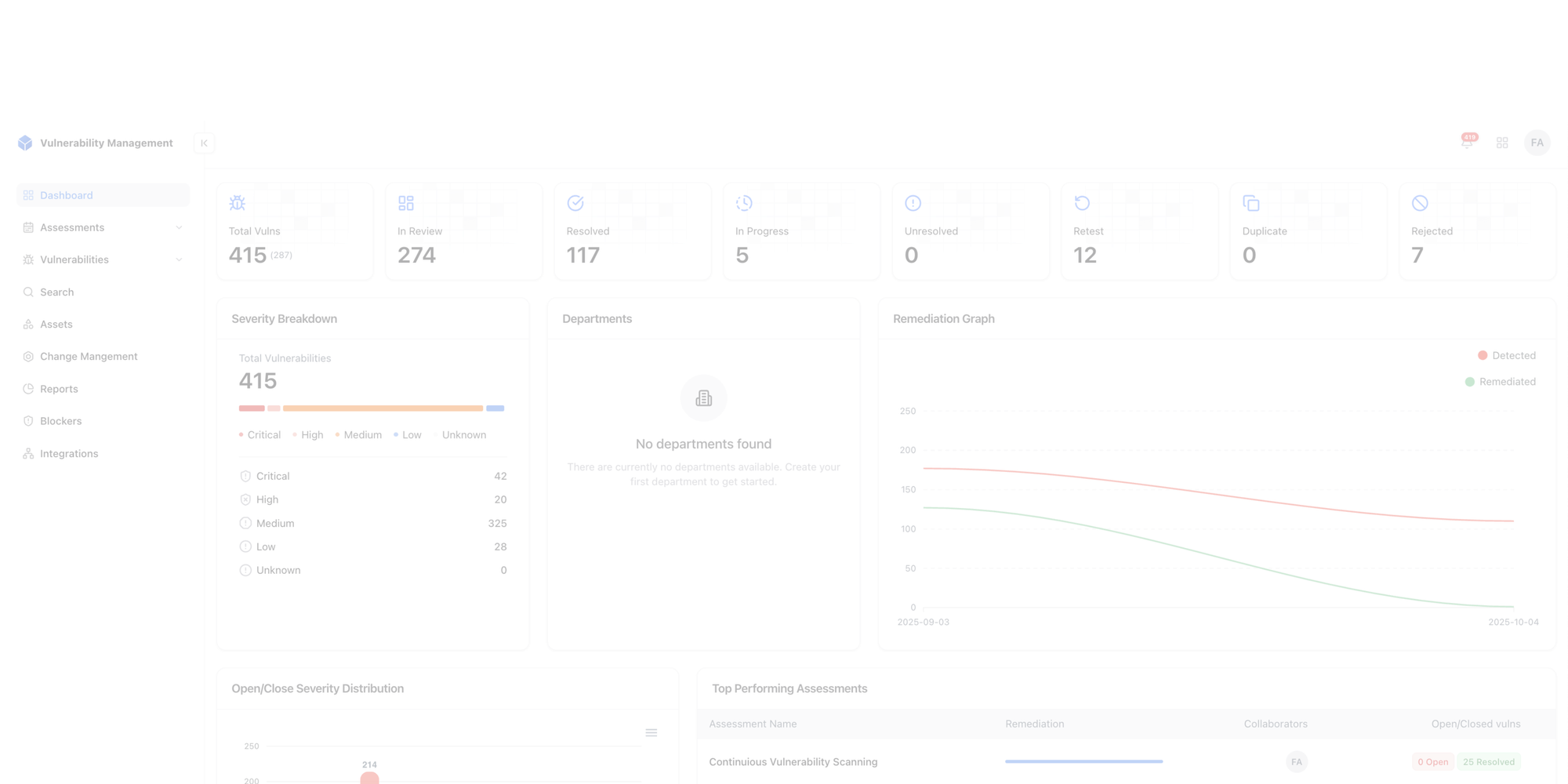
Centralise your Appsec
A single dashboard for visibility, collaboration, and control across your AppSec lifecycle.
Explore Live Demo